Risk Management in Trading: The 1% Rule Every Trader Should Know
Learn the 1% rule for trading risk management. Master position sizing, drawdown math, and how to protect your capital like a professional trader.
Most traders don't fail because they pick the wrong stocks or use the wrong indicators. They fail because one bad trade — or a string of bad trades — wipes out months of progress. The difference between traders who survive and those who blow up almost always comes down to one thing: risk management.
The 1% rule is the simplest, most effective risk management principle in trading. It states that you should never risk more than 1% of your total account on a single trade. This isn't about position size. It's about how much you stand to lose if the trade goes against you.
If you have a $10,000 account, your maximum loss on any single trade should be $100. Period. Regardless of how confident you feel, regardless of what the chart looks like, regardless of what someone on the internet said.
Why 90% of Traders Lose Money
The statistics are brutal. Research consistently shows that 70-90% of retail traders lose money. Most new traders blow their accounts within six months. Less than 5% are still actively trading and profitable after five years.
The primary culprit isn't bad strategy. It's poor risk management. The most common mistakes follow a predictable pattern:
- Oversized positions — Risking 10-20% per trade, meaning a short losing streak devastates the account
- No stop losses — Holding losing trades and hoping they recover, which is not a strategy
- Revenge trading — Doubling down after a loss to "make it back," which accelerates the damage
- Overleveraging — Using 50:1 leverage where a 1% move against you wipes out half your capital
Psychology accounts for roughly 80% of trading success. Most traders follow a predictable emotional cycle: hope, greed, panic, repeat. The 1% rule breaks this cycle by making any single loss insignificant to your overall account.
What the 1% Rule Actually Means
The 1% rule is often misunderstood. It does not mean you invest only 1% of your account in each trade. It means the maximum amount you can lose on any trade is 1% of your equity.
Here's the difference. Say you have a $25,000 account:
- Wrong interpretation: Buy $250 worth of stock (1% of account). This ignores where your stop loss is and could mean you're risking far more or far less than intended.
- Correct interpretation: Your maximum loss is $250 (1% of $25,000). Your position size is calculated backward from this number based on where your stop loss sits.
This is the key insight. Your position size is a function of your stop loss distance, not a fixed percentage of your portfolio.
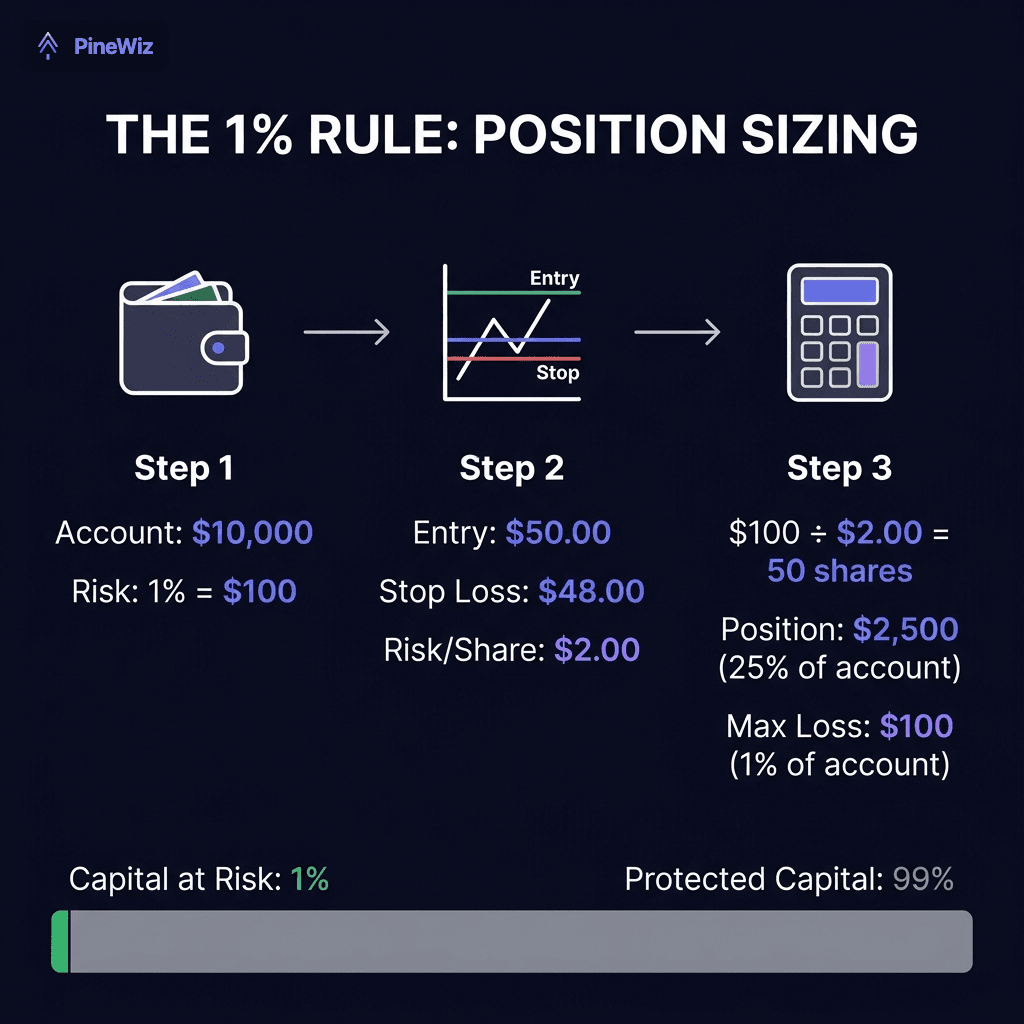
The Position Sizing Formula
The formula is straightforward: Position Size = (Account Balance x Risk %) / (Entry Price - Stop Loss Price)
Let's walk through a real example. Account balance: $10,000. Risk per trade: 1% = $100. Entry price: $50.00. Stop loss: $48.00. Risk per share: $2.00.
Position size = $100 / $2.00 = 50 shares. Total capital deployed: 50 x $50 = $2,500 (25% of your account). But your actual risk? Only $100, which is exactly 1%.
Now consider a different setup with the same stock. Entry price: $50.00. Stop loss: $49.00 (tighter stop). Risk per share: $1.00. Position size = $100 / $1.00 = 100 shares. Same account, same 1% risk, but double the shares because the stop loss is tighter. The risk in dollars stays constant. The position size adjusts.
This is how professionals think about every trade. The stop loss comes first. The position size follows.
The Drawdown Math That Changes Everything
Here's where the 1% rule proves its value. Drawdowns are inevitable in trading. Even a strategy with a 60% win rate — which is excellent — has a 100% probability of hitting 3 consecutive losses over time. Over 1,000 trades, longer streaks become virtually certain.
The question isn't whether you'll face a losing streak. It's whether your account can survive it.
Compare two traders facing 10 consecutive losses:
- Trader A (10% risk per trade): After 10 losses, their account drops by 65%. To recover, they need a 186% return. That's essentially starting over.
- Trader B (1% risk per trade): After 10 losses, their account drops by 9.6%. To recover, they need a 10.6% return. That's a normal month.
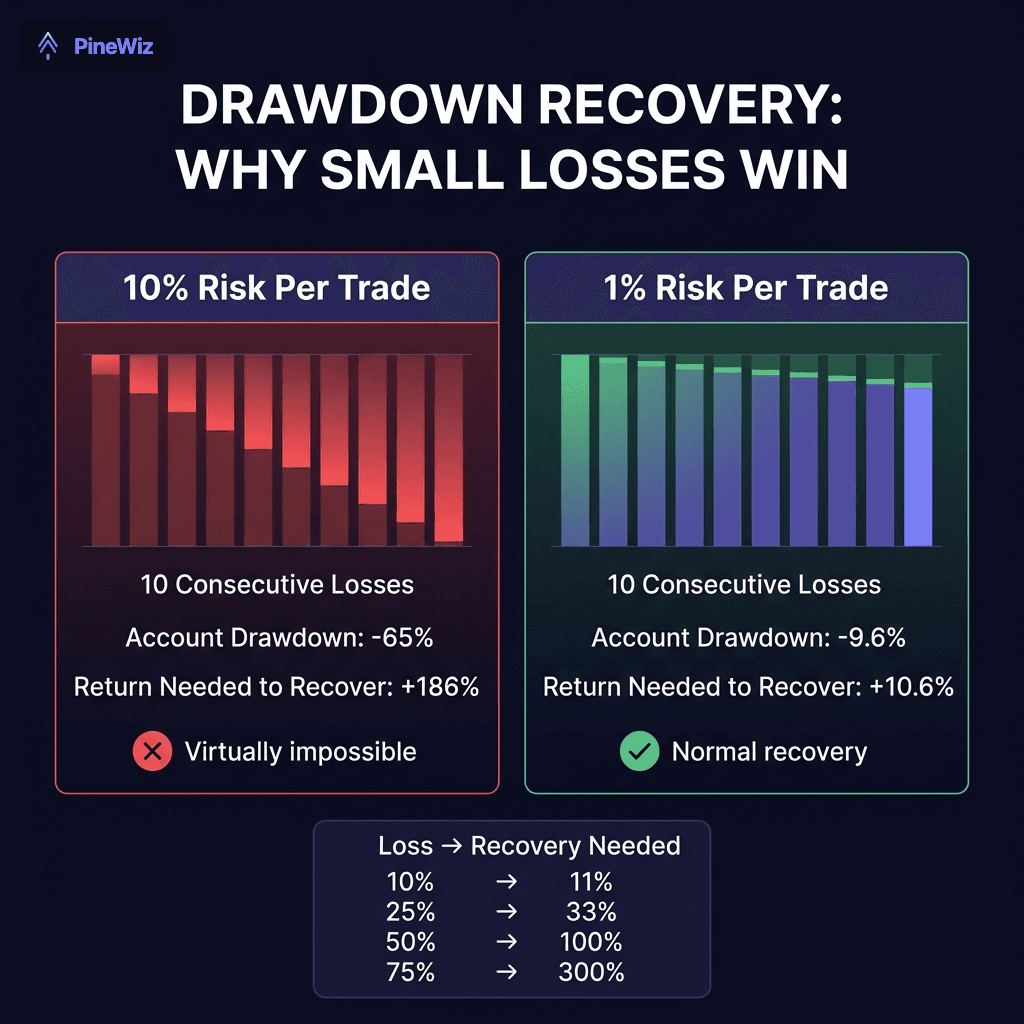
The recovery math is brutally asymmetric. A 10% drawdown requires an 11% gain to recover. A 25% drawdown requires a 33% gain. A 50% drawdown requires a 100% gain. And a 75% drawdown requires a 300% gain to get back to even.
This is why large losses are so devastating. They don't just reduce your capital — they exponentially increase the return needed to get back to even. With the 1% rule, you'd need to lose 100 consecutive trades to blow up your account. That's statistically almost impossible with any reasonable strategy.
Applying the 1% Rule: A Step-by-Step Process
Every trade you take should follow this exact sequence:
- Identify the setup. Find your entry signal based on your strategy — a moving average crossover, an RSI divergence, a breakout from consolidation.
- Determine the stop loss first. Place your stop loss at a level that invalidates the trade idea. Below a swing low for longs. Above a swing high for shorts. Based on chart structure, not an arbitrary dollar amount.
- Calculate risk per share. Subtract the stop loss from the entry price (for longs). This tells you exactly how much you stand to lose per share if the trade fails.
- Calculate position size. Divide your 1% risk amount by the risk per share. This gives you the exact number of shares to buy.
- Verify the risk-reward ratio. Check that your potential reward is at least 2x your risk. If your stop is $2 away, your target should be at least $4 away. If the risk-reward doesn't meet your minimum, skip the trade.
- Execute and respect the stop. Enter the trade at your calculated size and honor the stop loss. No moving it. No hoping. No exceptions.
Risk-Reward Ratio: The Other Half of the Equation
The 1% rule tells you how much to risk. The risk-reward ratio tells you whether a trade is worth taking. A 2:1 risk-reward ratio means you stand to make $2 for every $1 you risk. With this ratio, you only need to win 34% of your trades to break even. At a 3:1 ratio, you need just 25% winners.
This is counterintuitive for most beginners. You don't need to be right most of the time. You need your winners to be bigger than your losers.
Consider this scenario with a $10,000 account and 1% risk per trade: 10 trades taken at 2:1 risk-reward. 4 winners: 4 x $200 = $800. 6 losers: 6 x $100 = $600. Net profit: $200 (2% gain) despite losing 60% of trades. That's the power of combining the 1% rule with proper risk-reward ratios.
Automating Risk Management
One of the biggest advantages of coding your strategy is that risk management becomes automatic. There's no emotional override. No hesitation. No "just this once" exceptions.
In Pine Script, you can build position sizing and stop losses directly into your strategy. The strategy.exit() function handles stop losses and take profits automatically. ATR-based stops adapt to current volatility. Position sizing can be calculated from account equity in real time.
This means every backtest already accounts for proper risk management. You see realistic results from day one, not inflated numbers from oversized positions.
Tools like PineWiz make this even more accessible. When you describe your strategy — including your risk management rules — the AI generates Pine Script that implements proper position sizing, stop losses, and take profit levels automatically. No coding required. Your risk rules are baked into every line of code.
Common Mistakes to Avoid
Even traders who know the 1% rule often break it. Watch for these traps:
- "This setup is different" — No setup justifies abandoning risk management. The moment you make exceptions, you've lost the edge.
- Widening stops after entry — If the trade moves against you, the original stop was there for a reason. Moving it turns a small, planned loss into a large, unplanned one.
- Not accounting for gaps — In stock trading, prices can gap past your stop loss overnight. Account for this by slightly reducing position sizes on swing trades held overnight.
- Ignoring correlation — Three trades in the same sector are not three independent risks. If they all move together, you're effectively risking 3% on one bet.
- Adjusting risk based on recent results — Increasing risk after a winning streak or decreasing it after losses leads to poor position sizing at the worst possible times.
Build the Habit Before the Strategy
Risk management isn't exciting. It doesn't produce screenshots of massive gains. It won't get likes on social media. But it's the single skill that separates traders who last from traders who don't.
Start with the 1% rule. Apply it to every trade without exception. Calculate your position size before you enter. Set your stop loss before you think about profit. Let the math protect you from your own emotions.
The traders who will be profitable five years from now aren't the ones with the best entry signals. They're the ones who never risk enough on a single trade to put themselves out of the game.
Your strategy generates the edge. Risk management lets you survive long enough to realize it.
PineWiz Team
The PineWiz team specializes in Pine Script and algorithmic trading. We build AI tools that help retail traders turn their ideas into production-ready TradingView strategies and indicators — no coding required.
Ready to bring your idea to life?
Turn your trading ideas into Pine Script code without writing a single line.
Start Building