Tail Risk in Trading: What Geopolitical Chaos Means for Your Portfolio
Learn what tail risk is, how the Iran war, tariffs, and oil at $110 create market shocks, and how to build strategies that survive uncertainty.
Oil just broke $110 a barrel. The Strait of Hormuz — the chokepoint for 20% of the world's seaborne crude — is under blockade. The Nasdaq and Dow have entered correction territory. The VIX is sitting at 27, its highest sustained level in over a year.
If your trading strategy was built during the calm of 2024's AI boom, March 2026 is its stress test. And for most traders, that test is revealing a blind spot they never accounted for: tail risk.
Tail risk in trading isn't a theoretical concept you read about in textbooks. Right now, it's playing out in real time across every asset class. This post breaks down what tail risk actually is, why the current geopolitical landscape is a perfect storm for it, and what you can do to build strategies that survive when the world gets chaotic.
What Is Tail Risk (And Why Most Traders Ignore It)
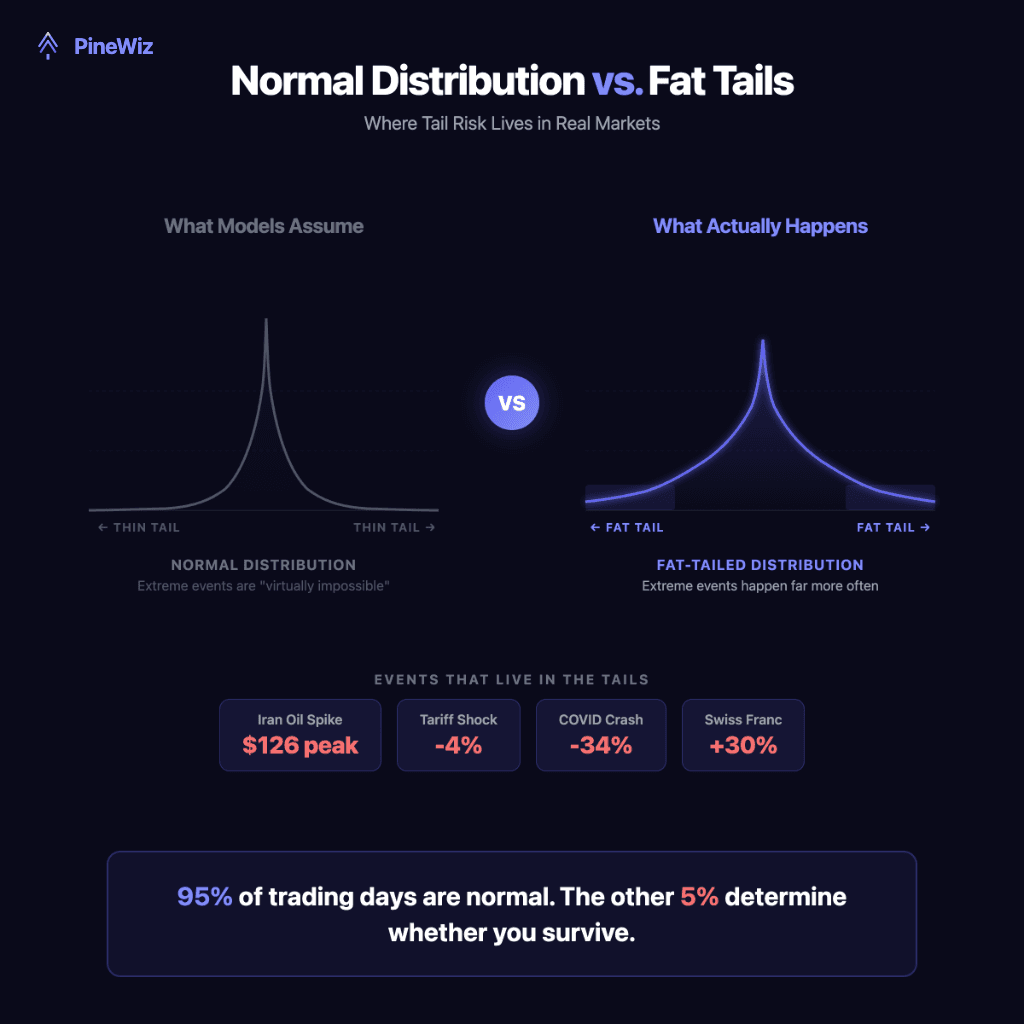
Every trading strategy is built on assumptions about how markets behave. Most of those assumptions follow a bell curve — the normal distribution. Small daily moves are common. Large moves are rare. Extreme moves are "virtually impossible."
Except they're not.
Real markets have what statisticians call "fat tails." The extreme ends of the probability distribution — where 5%, 10%, or 20% single-day moves live — occur far more often than normal distribution math predicts. Nassim Taleb famously called these Black Swan events: outcomes so far outside the model that the model doesn't even have a category for them.
So why do traders ignore tail risk? Three reasons. Recency bias — if markets have been calm for two years, your brain assumes they'll stay calm. Small sample sizes — most backtests cover hundreds of trades, not thousands, and may never include a tail event. And psychological comfort — it's easier to optimize for the 95% of "normal" days than to prepare for the 5% that determine whether you survive.
Imagine you've backtested a strategy over three years of calm markets. It wins 60% of the time. Then one morning, US strikes on Iranian oil infrastructure send crude past $110. Airlines, logistics, and consumer stocks gap down 3–5% before the open. Your stop loss at –2% executes at –4.3%. Three months of gains — gone in 90 seconds.
That's not a hypothetical. That's March 2026.
The 2026 Geopolitical Landscape: A Perfect Storm for Tail Risk
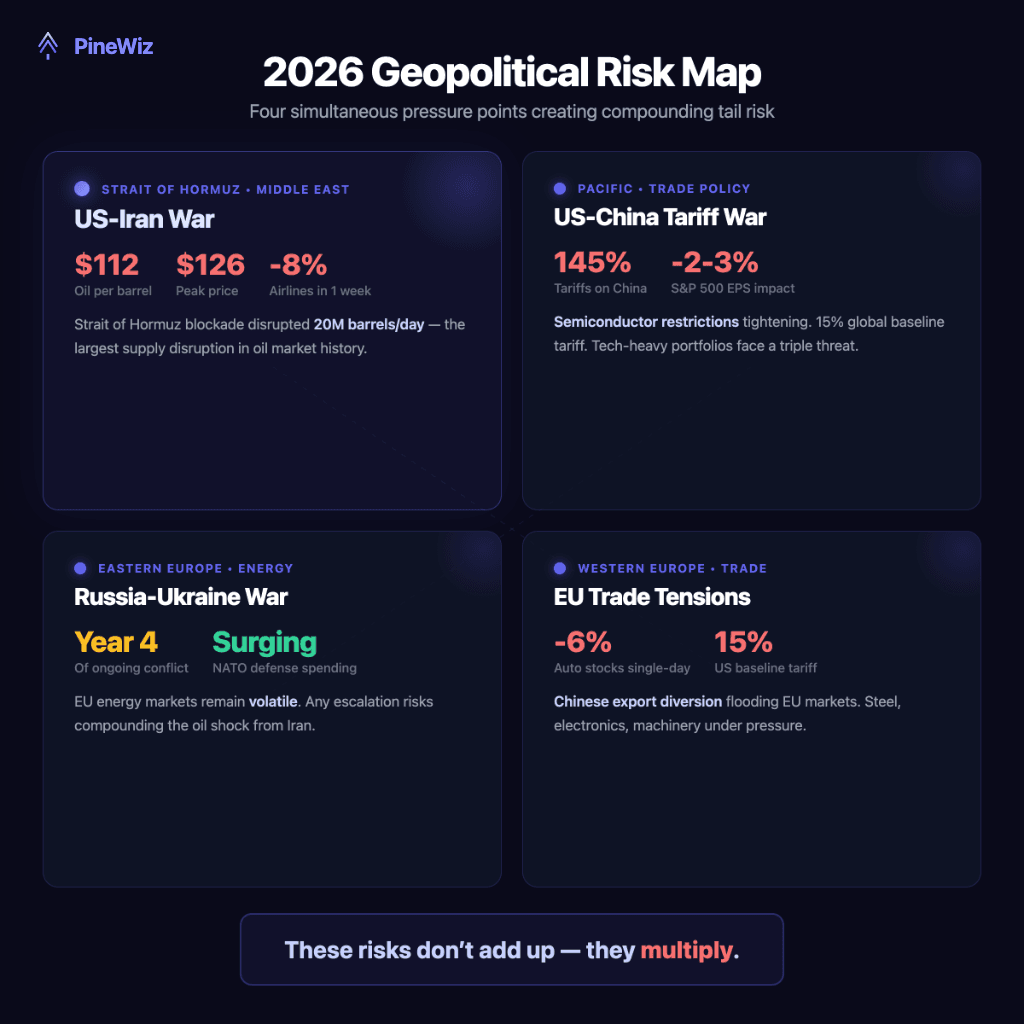
We're not dealing with a single risk event. We're dealing with four simultaneous pressure points, each capable of generating tail risk on its own — and compounding each other when they interact.
The US-Iran War and Oil at $110. This is the headline. Operation Epic Fury — a series of targeted US military strikes on Iranian infrastructure — began in late February 2026. Iran responded by blockading the Strait of Hormuz, cutting off 20 million barrels per day of oil transit. Brent crude surpassed $100 on March 8, peaked at $126, and currently sits around $112. The International Energy Agency has called it the largest supply disruption in the history of the global oil market. Airlines are hemorrhaging on fuel costs. Shipping and logistics costs have spiked. Consumer discretionary is getting crushed by inflation fears. Even tech is feeling it through data center energy costs.
US Tariff Escalation. The tariff landscape is chaotic. The Supreme Court struck down IEEPA tariffs on February 20, but the administration immediately imposed a 15% global baseline tariff under Section 122, with China facing 145%. Goldman Sachs estimates this could cut S&P 500 earnings per share by 2–3%. European markets face the added threat of diverted Chinese exports flooding their markets.
Russia-Ukraine War. Now in its fourth year, the conflict continues to create uncertainty in European energy markets and has driven a surge in defense spending across NATO countries. Commodity volatility remains elevated, and any escalation risks compounding the oil shock from the Iran conflict.
US-China Tech Decoupling. Semiconductor restrictions continue to tighten. For traders with tech-heavy portfolios, the combination of tariffs, energy costs, and supply chain uncertainty creates a triple threat that didn't exist 12 months ago.
The compound effect is what makes 2026 different. A US-Iran oil shock plus tariff escalation plus Russia-Ukraine energy uncertainty doesn't add up linearly — it multiplies. Each event amplifies the others, creating the kind of correlated stress that backtests built on calm periods simply can't predict.
When oil crossed $100 in early March, airline stocks dropped 8% in a week. Traders who were long Delta or United with tight stops got stopped out on day one — then watched oil keep climbing to $110. Meanwhile, energy traders long on crude thought they were safe — until a surprise diplomatic signal briefly crashed oil 5% intraday before it rebounded. Both sides of the trade got whipsawed. That's tail risk in action: it doesn't just hit one direction.
How Geopolitical Events Create Tail Risk in Markets
Understanding why geopolitical events are uniquely dangerous for traders requires understanding four mechanisms that don't show up in standard backtests.
Volatility clustering. Shocks don't arrive in isolation. The VIX spiked to 27.44 on March 26 — not from a single event, but from the cumulative weight of the Iran blockade, tariff uncertainty, and Tehran rejecting a 15-point peace proposal on the same day. One shock primes the market for the next. Volatility breeds volatility.
Correlation breakdown. During normal markets, holding airline stocks, consumer discretionary, and tech gives you diversification. During a geopolitical oil shock, inflation fear alone correlates everything downward. Oil at $110 drags down airlines through fuel costs, retail through consumer spending, and tech through energy expenses. Energy is the only sector surging — and even that whipsaws on diplomatic headlines. The "diversification" that protected you in calm markets fails at the exact moment you need it most.
Gap risk. Geopolitical news breaks outside market hours. Iran's IRGC commander declared "not a litre of oil" would pass through Hormuz on March 11 — and prices gapped at the open. Traders with stop losses at specific levels found their orders executing far beyond those levels. The 1% rule can be violated by overnight gaps during geopolitical crises, because your broker can't execute a stop loss when the market is closed.
Liquidity evaporation. During extreme events, bid-ask spreads widen massively. Market orders that would normally fill at the quoted price suddenly execute 1–2% worse. Limit orders don't fill at all. The market you thought you were trading — with tight spreads and instant execution — temporarily ceases to exist.
Historical Tail Risk Events Every Trader Should Study
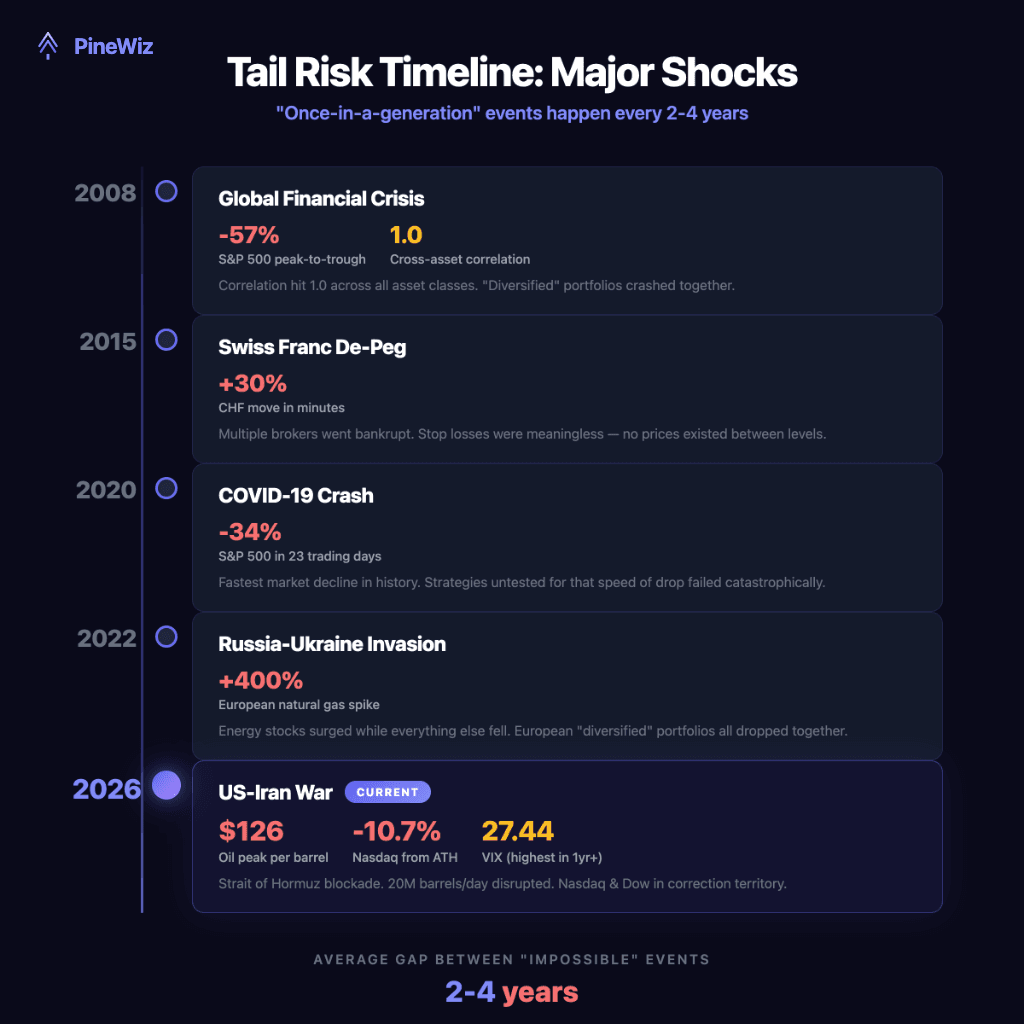
The 2026 Iran crisis isn't unprecedented. Tail risk events follow a pattern: they're "impossible" by normal distribution math, yet they happen every few years.
- 2026 — US-Iran War (Current). Oil supply disrupted through the Strait of Hormuz. Crude peaks at $126, currently around $112. Nasdaq and Dow enter correction territory. VIX sustains above 27. This is tail risk playing out in real time.
- 2022 — Russia-Ukraine Invasion. European natural gas spiked over 400%. Energy stocks surged while European equities cratered. Traders holding "diversified" European portfolios saw every position drop simultaneously.
- 2020 — COVID Crash. The S&P 500 dropped 34% in just 23 trading days. Strategies that had never been tested against that speed of decline failed catastrophically. Volatility hit levels not seen since 2008.
- 2015 — Swiss Franc De-Peg. The Swiss National Bank removed the EUR/CHF floor without warning. The franc moved 30% in minutes. Multiple brokers went bankrupt. Stop losses were meaningless — there were no prices between the old level and the new one.
- 2008 — Global Financial Crisis. Correlation went to 1.0 across nearly all asset classes. "Diversified" portfolios crashed together. The lesson was clear: during true tail events, the only diversifier is being out of the market.
The pattern is impossible to miss. These "once-in-a-generation" events happen every two to four years. The US-Iran situation is the latest proof that tail risk isn't an abstract concept — it's a recurring feature of markets that demands a concrete response.
Building Tail-Risk Awareness Into Your Trading Strategy
You can't predict the next tail event. But you can build strategies that acknowledge tail risk exists and respond to it automatically. Here are five concepts worth understanding.
Volatility-adjusted position sizing. Instead of trading a fixed position size, scale your exposure to current volatility. If ATR has doubled from its 20-day average, your position should be halved. This ensures you take smaller bets when the market is most dangerous. The same position sizing principles from the 1% rule apply — but with a volatility multiplier.
Correlation monitoring. Before entering a new trade, ask: how many of my current positions would move in the same direction during a geopolitical shock? If you hold five tech stocks, you don't have five independent bets during a tariff war — you have one. True diversification means holding assets with genuinely different risk profiles, not just different ticker symbols.
Maximum drawdown kill switch. Individual stop losses protect single positions. But during tail events, every position can hit its stop simultaneously. A strategy-level circuit breaker — "if total portfolio drawdown exceeds X%, close everything and stop trading" — prevents the death-by-a-thousand-cuts scenario where multiple small losses compound into a catastrophic drawdown.
Event-aware filters. Certain dates carry elevated tail risk: tariff announcement schedules, FOMC meetings, geopolitical summits, UN votes. Building a filter that reduces position size or pauses new entries around these dates is a simple way to step back from the market when the probability of a tail event spikes.
Regime detection. Markets operate in different regimes — calm and stressed. A VIX above 25, sustained high ATR, or rapid correlation shifts all signal a stressed regime. Strategies that behave differently in stressed regimes — tighter stops, smaller positions, fewer entries — are inherently more resilient to tail events.
A trader using regime detection would have seen the VIX spike above 27 when the Iran strikes began and automatically paused new entries. They missed the chaos — and the 5% overnight gap in airlines that wiped out traders who were fully exposed. Meanwhile, a trader with an oil-price filter triggering above $100/barrel would have automatically reduced non-energy positions, limiting the damage from the supply shock.
How PineWiz Can Help You Prepare
The concepts above are powerful — but implementing them in Pine Script requires coding knowledge that most traders don't have. That's where PineWiz comes in.
PineWiz lets you describe tail-risk detection rules in plain English and generates the Pine Script to implement them. Instead of learning Pine Script syntax, you focus on the risk logic:
- "Lower my position sizing to half when ATR is double its 20-period average"
- "Skip overnight trades when volatility is elevated — only take intraday entries"
- "Tighten my stop loss from 2% to 1% when the market is in a downtrend"
- "Pause my strategy entirely if it hits 3 consecutive losing trades in a single session"
- "Only enter long positions when price is above the 200 EMA — stay flat otherwise"
The traders who survive tail events aren't the ones who predicted them. They're the ones who built systems that respond automatically when the world gets chaotic. Your next strategy doesn't just need a good entry signal — it needs a plan for when oil hits $110 and the VIX is screaming.
PineWiz Team
The PineWiz team specializes in Pine Script and algorithmic trading. We build AI tools that help retail traders turn their ideas into production-ready TradingView strategies and indicators — no coding required.
Ready to bring your idea to life?
Turn your trading ideas into Pine Script code without writing a single line.
Start Building